
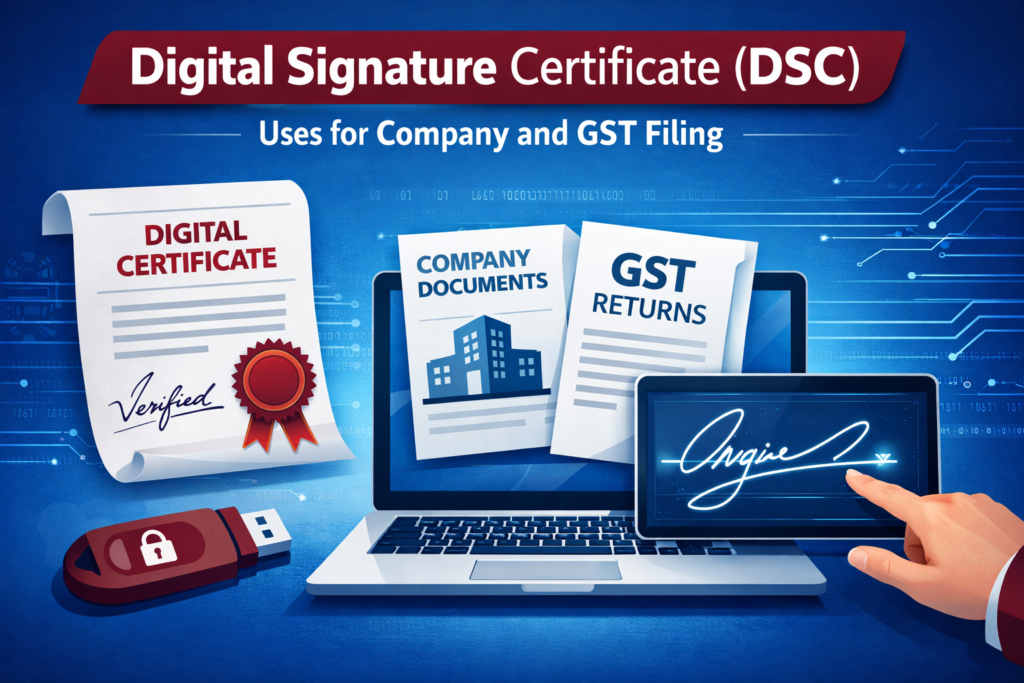
Digital Signature Certificate (DSC)
Introduction
In today’s digital era, businesses and individuals are rapidly shifting towards online documentation and transactions. A Digital Signature Certificate (DSC) plays a crucial role in ensuring secure, authentic, and legally valid digital communication.
Whether you are filing taxes, registering a company, or signing contracts online, DSC is essential for maintaining security and compliance in India.
What is a Digital Signature Certificate (DSC)?
A Digital Signature Certificate (DSC) is a secure digital key issued by certifying authorities to verify the identity of the certificate holder. It is used to digitally sign documents, ensuring authenticity, integrity, and non-repudiation.
In simple terms, a DSC is the digital equivalent of a handwritten signature or stamped seal.
Why is DSC Important?
1. Authentication – Confirms the identity of the signer.
2. Data Integrity – Ensures that the document is not altered after signing.
3. Security – Uses encryption technology to protect sensitive data.
4. Legal Validity – Recognized under the Information Technology Act, 2000 in India.
Types of Digital Signature Certificates
1. Class 1 DSC
Used for basic email verification.
Low level of security.
2. Class 2 DSC (Now mostly replaced)
Previously used for MCA, Income Tax filing.
Now discontinued and replaced with higher classes.
3. Class 3 DSC (Most Common)
High level of security.
Required for:
-Company registration
-GST filing
-E-tendering
-Trademark filing
Uses of Digital Signature Certificate
1. Company Registration (MCA)
2. GST Filing
3. Income Tax Filing
4. Trademark & IP Filing
5. E-Tendering & Government Contracts
Benefits of DSC
1. Saves time (no physical paperwork)
2. Cost-effective (reduces printing & courier cost)
3. High security with encryption
4. Legally valid and accepted
5. Easy and fast online transactions
For Organizations
Company PAN Card
Certificate of Incorporation
Authorization Letter
Director’s KYC Documents
For Individuals
PAN Card
Aadhaar Card
Passport-size photo
Email ID & Mobile Number
Validity of DSC
A Digital Signature Certificate (DSC) is typically issued with a validity period of 1 to 3 years, depending on the type of certificate and the certifying authority. During this period, it can be used for secure digital transactions, document signing, and government filings. Once the DSC expires, it becomes invalid and cannot be used further. Therefore, it is important to renew it on time to avoid disruptions in activities like GST filing, MCA compliance, or e-tendering. The renewal process is simple and can be completed online with basic verification.
How to Apply for Digital Signature Certificate (Step-by-Step)
Step 1: Choose a Certifying Authority – Select a government-approved DSC provider.
Step 2: Fill Application Form – Submit personal and business details.
Step 3: Submit Documents – Upload required KYC documents.
Step 4: Verification Process – Complete video or OTP verification.
Step 5: Receive DSC – Download DSC in USB token or cloud format.
Digital Signature Certificate (DSC):
A Digital Signature Certificate (DSC) is a highly secure, certificate-based digital signature that uses encryption technology to ensure authenticity and data integrity. It is widely used for official and government-related purposes such as GST filing, MCA submissions, income tax returns, and e-tendering. DSC is issued by authorized certifying authorities and often requires a USB token or cloud-based storage for usage. It is mainly preferred by businesses, companies, and professionals because of its high level of security and legal acceptance for sensitive transactions.
Electronic Signature (eSign):
An Electronic Signature (eSign) is a simple and convenient way to sign documents digitally using Aadhaar-based OTP or other authentication methods. It does not require any physical token or hardware, making it quick and easy to use for individuals. eSign is commonly used for basic document signing such as agreements, forms, or approvals where high-level security is not mandatory. While it is also legally valid under Indian law, it offers comparatively moderate security and is best suited for less complex and quick transactions.