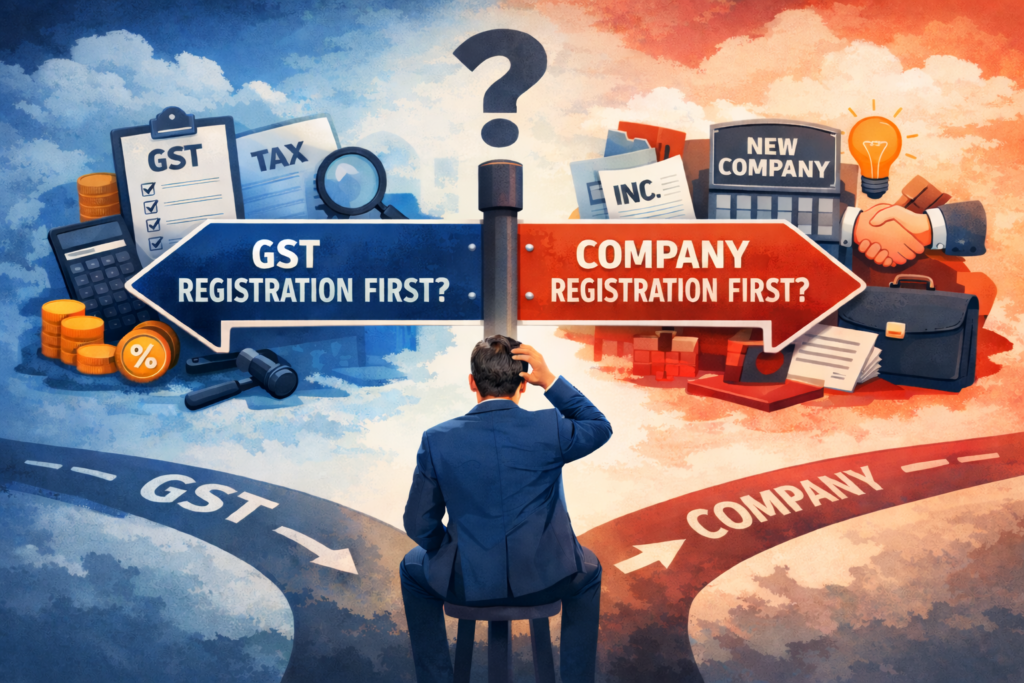
Should You Register for GST Before Company Incorporation?
Starting a business in India involves multiple legal and tax registrations. One of the most common questions new entrepreneurs ask is whether GST registration should be done before company incorporation or after it. Understanding the correct sequence is important because GST registration depends on the legal structure of the business and certain compliance requirements.
What is GST Registration?
GST (Goods and Services Tax) is an indirect tax levied on the supply of goods and services in India. Businesses that cross the prescribed turnover limit or fall under mandatory categories must obtain a GSTIN (Goods and Services Tax Identification Number).
| In most states, GST registration becomes mandatory when: |
| Goods turnover exceeds ₹40 lakh |
| Service turnover exceeds ₹20 lakh |
Can You Register for GST Before Company Incorporation?
No — generally you cannot register GST before incorporating a company . GST registration is linked to the PAN of the business entity and requires proof of business constitution such as:
1. Certificate of Incorporation
2. Partnership deed
3. Proprietorship documents
4. PAN of the entity
Because of this, a company must legally exist first before applying for GST.
However, there are three practical situations where GST may appear to be applied “before” incorporation.
Situations Where GST Can Be Applied During Company Formation
GST Registration through SPICe+ Form (Integrated Registration)
When incorporating a Private Limited Company or LLP, entrepreneurs can apply for GST registration during the company registration process through the SPICe+ AGILE-PRO form on the MCA portal.
This integrated form allows startups to apply for:
GST registration
EPFO registration
ESIC registration
Professional tax (in some states)
Bank account opening
This means GST registration can be processed alongside incorporation, saving time.
Proprietorship Businesses
If you start a sole proprietorship, technically there is no formal company incorporation required.In this case, GST registration can be the first legal registration for the business because the owner’s PAN is used as the business PAN.
Example:
Freelancers
Consultants
Small digital marketing agencies
Online sellers
Voluntary GST Registration
Even if a business has not crossed the turnover threshold, entrepreneurs can still apply for voluntary GST registration.
This is often beneficial for:
B2B businesses
Startups working with corporates
Export businesses
Why Most Startups Register GST After Company Incorporation
For Private Limited Companies, LLPs, and Partnerships, GST registration usually happens after incorporation for the following reasons:
Legal Entity Requirement
GST requires the legal identity of the business, including:
1. PAN of the company
2. Registered office address
3. Director/partner details
4. Certificate of incorporation
5. Without these, the application cannot be completed.
Banking Requirements
Many GST applications require bank account details of the business. A company bank account can only be opened after incorporation, making GST registration easier afterward.
Compliance Accuracy
Registering GST after incorporation ensures that:
1. Business name matches legal documents
2. Address proof is accurate
3. Directors or partners are correctly listed
This reduces the risk of rejection.
5. When Should You Register for GST?
Mandatory Registration Situations
You must register if you:
1. Cross the turnover threshold
2. Sell goods or services interstate
3. Sell on e-commerce platforms like Amazon or Flipkart
4. Are required under specific GST categories
Even a single interstate transaction may trigger GST registration requirements.
Optional (Voluntary) Registration
Voluntary registration may be beneficial if:
1. You want to claim Input Tax Credit
2. Your clients require GST invoices
3. You want to build business credibility
6. Key Benefits of Early GST Registration
Registering for GST at an early stage can provide several strategic advantages for startups and growing businesses. It not only ensures legal compliance but also helps businesses operate more professionally and expand their market reach.
1. Input Tax Credit Benefits
GST-registered businesses can claim Input Tax Credit on purchases such as office equipment, software, raw materials, and business services. This helps reduce overall tax liability and improves cash flow.
Professional Business Image
Having GST registration increases trust among corporate clients, vendors, and investors, as many companies prefer working with GST-registered businesses.
Interstate Business Expansion
GST registration allows businesses to sell goods and services across India without restrictions, making nationwide expansion easier.
Access to E-commerce Platforms
Most major online marketplaces require sellers to have GST registration before listing their products or services. Early registration therefore allows businesses to enter and grow in the e-commerce market quickly.
7.Documents Required for GST Registration
Typical documents required include:
1. PAN card of the business
2. Aadhaar of promoters or partners
3. Certificate of incorporation
4. Business address proof
5. Bank account details
6. Digital Signature Certificate (DSC) for companies
Applications are submitted online through the GST portal.
GST Registration Timeline (2026)
In 2026, GST registration has become faster due to improved online verification and Aadhaar authentication. For low-risk businesses, approval usually takes around 3 days, while standard applications may take 5–7 days. In cases requiring additional verification or document checks, the process can take 10–15 days. Once approved, the business receives its GSTIN and GST registration certificate.